
As part of our commitment to responsible water use in the production of our products we conduct extensive monitoring to ensure full compliance with all our regulatory requirements.
Monitoring river water quality is extremely complex, due to the challenges from multiple pollution sources, for example field and road run-off and urban drainage, to detection thresholds of contaminants which can be very low – significantly lower than drinking water – and difficult, or even impossible to test for. In this article, we explore the realities and challenges of compliance, how we work with the Environment Agency (EA) and the steps we take to minimise our impact while providing the very best products for our customers.
But how do we do it? You can read more here.
Washing Salad Leaves with Minimal Environmental Impact
Our Washing Process
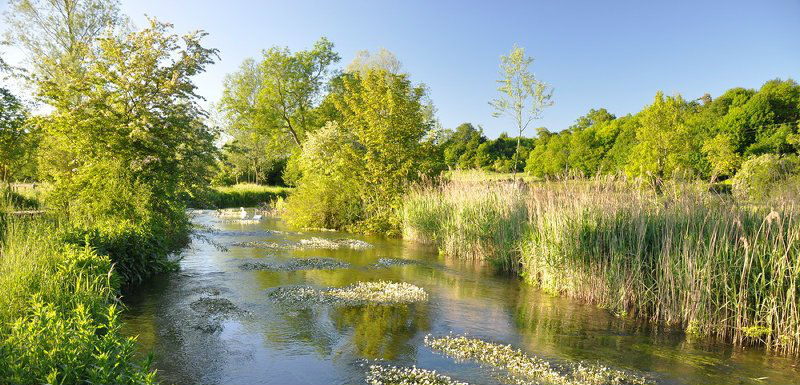
Water is essential to our salad washing process, and we take great care to ensure our operations have minimal environmental impact. Our salads are washed using water sourced from the chalk aquifer. After washing our salads this water is returned to the environment through the Bourne Rivulet.
How It Works
- We extract water from deep underground via boreholes in the aquifer.
- This water is used in our salad washing process and for growing Watercress. We are ‘non-consumptive’ for our watercress and salad washing in the UK – this means we return our water to the local environment.
Once the process is complete, the water from the salad washing is screened to remove any remaining leaves and then allowed to slowly flow through two large watercress beds to allow any sediment to drop out before being discharged to a channel that feeds into the Bourne Rivulet approximately 400 metres downstream.
Monitoring & Quality Control
We conduct extensive water monitoring checks, above and beyond those required, to ensure compliance with all our regulatory requirements:
- Decades of Testing – We have been rigorously testing water quality for years to ensure compliance with environmental regulations. We not only test our water chemistry but also assess the health of the aquatic biology in the river and surrounding channels at seven distinct locations, above, within, and below our operations.
- The Environment Agency (EA) made us aware that we would need to check our water for pesticide residue that may be washed off salad leaves. And we therefore embarked on a seasonal programme of pesticides testing in 2022.
- The EA asked us to report our results as annual average concentrations and maximum concentrations. We did this in 2022 and generated a very large amount of data that we made available to the EA. There were 9 results showing detections above the EA issued level of detection, and these were derived from the 14,512 individual test results from across the sampling year.
- We then set up a trial ozone water treatment in 2023 to understand how these trace levels could be removed from the water.
- Not all the levels of detection required by the EA could be met by the laboratory nor by the laboratory used by the EA. Therefore, the analysis employed could not always provide scientifically provable results. That’s why we worked with the EA for the next year to agree scientifically provable levels of detection of pesticides. We also developed a new sampling and analysis methodology that enables much lower levels of detection and produce scientifically robust data. In June 2025 we tested this methodology through a new water treatment technology. The results showed that this form of water treatment is highly effective at removing potentially present pesticides. However, some of the very low levels of detection were still too low for the laboratory to scientifically prove. We are continuing to work with the EA and laboratory to agree scientifically provable analysis.
- We have conducted a risk assessment to establish the likelihood of pesticides entering the water process. This assessed the persistence on the plant tissue once is has been applied in the field, noting applications are diluted and administered under strict guidelines. The second part of the assessment looked at degradation rates in water. The lower the persistence on plant tissue and the faster the degradation rate in water indicates that certain pesticides present extremely low risk to the environment from our washing facility. All data was obtained from the PPDB: Pesticide Properties Database and BPDB: Biopesticides Database hosted by the University of Hertfordshire.
- We also monitor our river biology. The Bourne Rivulet and local streams support spawning sites for wild brown trout and are teeming with all age classes, which reflects good water quality. Our waterways also have good healthy ranunculus (water crowfoot) beds that provide habitat and shelter to bullhead and the aquatic invertebrate communities associated with chalk streams. Key predators such as otters and kingfishers are resident on our site indicating a good source of food and therefore healthy ecosystem.
The Challenges of Monitoring & Regulations
Monitoring water quality, especially for pollutants like pesticides – presents significant challenges, many of which extend beyond farming alone. Although pesticide use is a key factor in modern farming, including organic farming, to ensure crops remain healthy and productive.
Monitoring river water quality is an incredibly complex task due to several key factors:
- Multiple Pollution Sources – rivers are exposed to contaminants from many sources, including rainwater runoff, urban drainage, and, in some cases, untreated sewage. Farming is just one part of the broader picture.
- Low Detection Limits – environmental pesticide detection thresholds set by regulators can be so low that UK laboratories often lack the capability to test for them. In fact, for 17 out of 88 required pesticide tests, no UK laboratory can currently measure the levels set by the EA – and these limits are less than those constraints placed on wastewater treatment, that is then discharged to the rivers and groundwater. This means that while we invest heavily in testing, current guidelines make it impossible to monitor every potential contaminant in the water.
- With this presenting an industrywide issue, we continue to work proactively with the EA to refine our testing methods and seek out new solutions for this reporting.
Regulatory Compliance & Permits
We also work closely with the EA and our customers to ensure full compliance with all regulations:
- We follow regulatory advice from the EA and are fully compliant regarding pesticide usage on our farms and our suppliers’ farms in line with EU and UK pesticides regulations and our customers policies.
- We hold an abstraction license, allowing us to responsibly extract water for our operations.
- We hold two discharge permits, ensuring all water returned to the river meets strict environmental standards.
- We are in the process of varying these discharge permits, for which we have applied to the EA. This does not change how we work but is subject to new pesticide monitoring criteria as set out by the regulator. The revision of discharge permits currently under discussion does not ask for an increase in volume discharged to the Bourne Rivulet.
- We have provided a comprehensive suite of data and information for the permit variation.
Looking Ahead
We continue to invest in the development of new water‑treatment solutions, exploring advanced technologies and applying scientifically robust analytical methodologies to further enhance the precision and effectiveness of our approach.
Our latest water treatment system is ready to progress through the EA’s permit‑variation process, a mandatory step before installation. We will be able to submit this application as soon as the determination of our existing permit variation has been completed by the EA.
These actions form part of our long‑term commitment to continuous improvement and transparent collaboration with regulators. We remain firmly dedicated to meeting – and where possible, exceeding – the industry’s highest standards for environmental protection and ethical practice.